
Matthew
Good morning. What an exciting day. Get to celebrate a couple of baptisms. Grateful for Ben and Joshua's decisions. I was backstage right as Josh came up out of the water.
So he lifted up a towel and he held it between us and gave me a hug. So I think I am still dry, but got to celebrate that with him. And we're excited to see people taking steps of obedience to Jesus like that. Glad you're with us today. Some people have suggested that I have a bizarre sense of humor.
In my opinion, those people simply lack the intellectual sophistication to appreciate brilliant comedy. But whatever you call it, I come by it honestly. When I was a kid, my uncle Paul Boatman said to me, ask me if I'm an orange. So I asked him, are you an orange? And he said, no.
My uncle then asked me, what's the difference between a duck? And after a brief pause, he said, ice cream cones don't have wings. Now, some people call those anti jokes, and the fact that very few of you are laughing illustrates to me that you would probably think of that way. Other people call them stupid, but there are lots of them. Google anti joke and you'll find a treasure chest of ridiculousness.
For example, what did one Frenchman say to the other? I have no idea. I don't speak French. Or what did the farmer say after he lost his tractor? Where's my tractor?
Why is six afraid of seven? Actually, it's not. See, numbers have no consciousness and they're therefore incapable of feeling fear. Or what did Buzz Lightyear say to Woody? All kinds of stuff.
I mean, there were four Toy Story movies, right? What do you call a cop with a wooden leg? Officer.
So maybe you're chuckling right now. Maybe you're rolling your eyes and thinking, who hired this moron? But what I'm trying to share with you is that from Monty Python to Weird Al Yankovic, everything in between, I've always found absurdity entertaining. And I'm not alone. Did you know that November 20th is national absurdity Day?
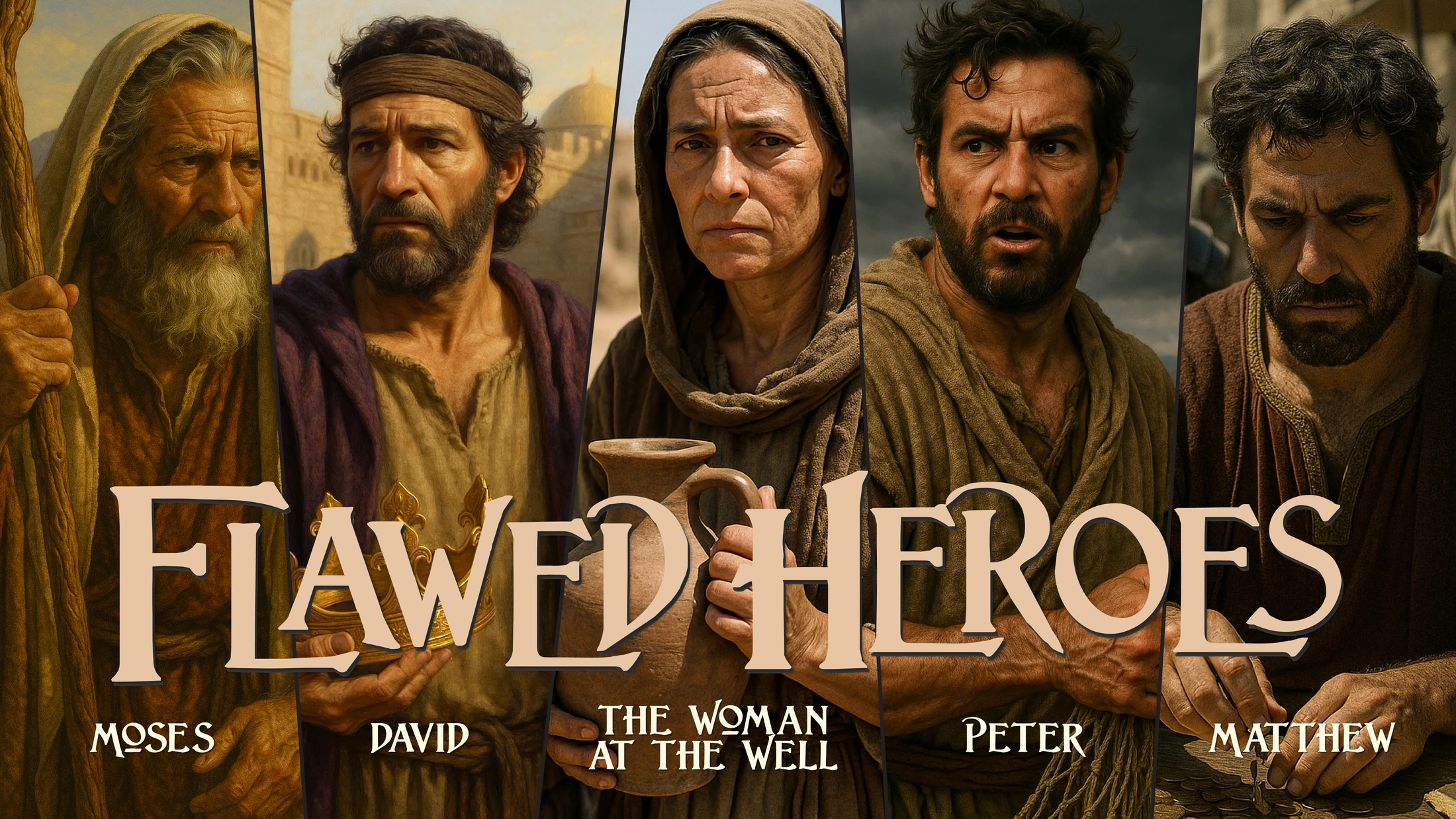
Mark your calendars. Let's get together and do something ridiculous. So in this series, we've been looking at biblical characters that God used in heroic ways, but people who had major flaws. People who, if you and I were choosing our own ministry team, we probably wouldn't pick. When it comes to who God uses, many of his choices seem pretty absurd by human standards.
Today we're going to focus on a guy by the name of Matthew, who wrote the first book in our New Testament. And at face value, Matthew looks like another Absurd draft pick. We first encounter Matthew in the gospel that bears his name, the book of Matthew, chapter 9, where we read in verse 9 that as Jesus went on from there, he saw a man named Matthew sitting at the tax collector's booth. Follow me, he told him. And Matthew got up and followed him.
Like Jesus encounter with the woman at the well that we talked about last week, this conversation that he had with Matthew seems pretty illogical and absurd. I mean, it's not surprising that Jesus went on from there, because Jesus moved around a lot. And it's not surprising that Jesus saw a man. He was an expert at noticing people. It's not surprising to me that a man named Matthew would show up in the Bible, because in my very humble opinion, Matthew is a fantastic name, one of the best, really.
It's also not surprising that Jesus would talk to someone sitting at the tax collector's booth, because Jesus talked to all sorts of people. But what is shocking is that Jesus would walk up to a tax collector and say, follow me. And here's why. If you've read very much in the Gospels, the first four books of the New Testament, all about Jesus, you've probably gathered that tax collectors were not very popular. They weren't thought very highly of, and why should they have been?
I mean, would any of us list paying taxes as our favorite thing to do? Anybody love to pay taxes? I was just hoping for a single volunteer because I was going to give you the opportunity to pay mine, but nobody in either service. When was the last time you went to lunch with an IRS agent just for fun? Anybody?
Well, the IRS is very different from the tax system of Jesus Day. The Roman Empire funded its occupation of conquered territories like Israel by taxing the locals. Tax collection rights for various districts were sold to the highest bidder. So various Jews would estimate how much cash they could wring from the residents of a particular region. And whoever promised the largest sum got the job.
And once contracts were awarded, tax collectors routinely overcharged people. They skimmed the margin, and they enjoyed an extravagant lifestyle. By helping the Romans extort funds from other Jews, they got rich doing a job that few people wanted and that left them with very few friends. So when Jesus assembled his team of disciples, when he called this group of men he would mentor for three years and then release to take his message to the world, he naturally picked Matthew the tax collector. Does that seem absurd to anybody else?
When we hire people to work on our church staff, we consider both their competencies and their character. And I can tell you that regardless of staff Role. Two traits that we always look for are moral integrity. We look for people who are trustworthy and honest, people who are committed to doing what's right. We also look for people who are respectable.
We want people who are thoughtful, team minded, who have a good reputation. And Matthew had neither. We have some church staff positions open right now and if we received an inquiry from someone with Matthew's resume, we probably wouldn't even interview them. You probably wouldn't either if you work in hr. We don't know all that much about Matthew, but here's what we do know.
He was also called Levi. There are multiple characters in Scripture who are known by more than one name. He's mentioned by name only seven times, just seven times in the Gospels. And three of those occur in lists of the names of Jesus disciples. So our main clues about Matthew's life are all contained in a single episode that's recorded in Matthew chapter nine.
It's also paralleled in Mark chapter two and Luke chapter five. And it is not a very detailed character sketch. So we have to do a little bit of deductive reasoning to try to piece together Matthew's life before this moment. As a tax collector, Matthew was probably educated in mathematics and Aramaic and Greek. So he may have been the most educated of Jesus disciples.
And the content of Matthew's Gospel, which draws heavily from the Old Testament Scriptures, suggests to us that he may have had some synagogue education as well. Matthew is by far the most Jewish of the four Gospels. He he quoted or alluded to the Old Testament more than 130 times, which is more than Mark, Luke and John combined. And that means the Old Testament law, with all of its emphasis on fairness in business transactions and honest weights and measures, and taking care not to exploit the poor and oppressed would have been very familiar territory for Matthew. But to even want to be a tax collector, a person had to be greedy.
You kind of had to be opportunistic and callous toward other people. So I can't help but wonder, how did a biblically educated Jew wind up in cahoots with the Romans, gouging his fellow Jews for money? We don't know. Did Matthew rebel against a heavy handed, rules oriented Jewish upbringing and decide to stick it to the man by taxing other Jews? Was he just so materialistic that he was willing to do whatever it took to enjoy that extravagant lifestyle he'd always dreamed of?
Was Matthew just so lukewarm and apathetic about his faith that he preferred selling out to the Romans over standing by his own People in their struggles. The Bible doesn't address any of that. The Bible doesn't tell us about Matthew's upbringing or his education, so we simply don't. But whatever route it took, it seems that Matthew knew Scripture well, yet it didn't have much traction in his life.
Now, do we have any experience with that? Knowing the truth, having a clear understanding of what God has said is right and what God has said is wrong, and yet living our lives in a way that reflects very little of that? I mean, have you ever known a student who attended a private Christian school but had little interest in opening their Bible? Or a Bible college student preparing for ministry who rarely rolls out of bed on Sunday mornings to make it to church? Or a preacher or elder's kid who has completely deconstructed and rejected their faith?
Or a minister, perhaps, who officiated weddings and who counseled couples and then damaged his own marriage and family and ministry by having an affair? Or a student who went from being a leader in the youth group to a life of addiction. Or someone who understands God's design for marriage and sexuality and yet still chooses porn and promiscuity. Or a person who knows that God so loved the world but has very little compassion for people from other places and cultures. Or perhaps someone who's been blessed with substantial financial resources, but who balks at biblical teaching about generosity.
So we don't know the specifics of Matthew's story, but I don't think it was unique. There have always been people who know the truth, but just don't live by it and wind up in places that feel kind of hard to come back from. And once Matthew got to that place, I imagine that he felt stuck. I mean, his job and his reputation had alienated him from his own people, so going back to his Jewish roots wouldn't be an easy thing. And walking away from the prestige, the income, the wealth that he had attained as a tax collector, that would be hard, too.
So whether Matthew stayed where he was or walked away from that life, he. He was going to travel a difficult road. It's not hard to see Matthew's flaws. But let's talk for a minute about the hero part of his story. Why in the world is Matthew listed in this group of flawed heroes we're examining in this series?
Well, reason number one is this because Matthew surrendered his life to Jesus, and that is so important. I mean, how often do we read something convicting in our Bibles or see someone in obvious need of something that we are personally able to provide or Sing a worship lyric about God's worthiness of our total devotion, or learn of an opportunity to give or to serve, or sense the Holy Spirit prompting us to act in some way. And instead of responding in obedience, we simply let the moment pass and we stay in our familiar and comfortable groove and we continue on with our lives unchanged.
One of the things we see in the life of Matthew is our lives don't change simply because we hear something. Sometimes people catch me after the service and they say, really enjoyed the message and I'm grateful for that. I mean, I don't want people to come and say, I hated that. That was painful to listen to. I fell asleep.
But our enjoyment is not the primary purpose of the Word of God, nor is it the primary purpose of our preaching here. Our lives don't change simply because we see something or because we read something, or because we feel something. Our lives change when we act on what God is calling us to do. Let me say that again. Our lives change when we act on what God is calling us to see.
Nearly everything we know about Matthew is contained in these three short, parallel Gospel accounts of the day he met Jesus. So we hardly have a detailed biography. But it isn't hard to gather that Matthew had somehow, in a way that Scripture doesn't specify, he had hit a wall. He had reached a turning point. Something had happened in Matthew's life to cause him to realize that he was lost, that he was broken.
He knew there was more to life than the way he was living. And we know that because all three of the gospels that mention his story record that when Jesus said, follow me, Levi, Matthew got up, left everything and followed him. Now we don't know the whole story. We don't know what sort of wake up call Matthew received. We don't know how he hit rock bottom.
We don't know when he arrived at that moment of clarity. But somehow he knew it was time for a change. And when Jesus called, Matthew answered. With his life, he surrendered. He walked away from the lifestyle that he had established.
He followed Jesus into a future that was uncertain, but that he was confident would be more rewarding than the life he'd been living. You know, it was Matthew who later recorded these words of Jesus where Jesus said, whoever wants to be my disciple must deny themselves and take up their cross and follow me. For whoever wants to save their life will lose it. But whoever loses their life for me will find it. And I would bet in light of Matthew's extravagant tax collector lifestyle, that Jesus next sentence really stuck him Right between the ribs.
What good will it be for someone to gain the whole world yet forfeit their soul?
Matthew met Jesus and his life pivoted in a huge way. And we know his commitment to Jesus wasn't just an impulsive short lived season because like virtually all of Jesus other apostles, the Matthew later died a martyr's death preaching as a missionary. And if we stopped right there, we would have a powerful, a beautiful, a touching story of redemption and courage. But Matthew's story doesn't stop there. See, the second reason that I consider Matthew a hero is because Matthew did not keep Jesus to himself.
In Matthew's own account of how he met Jesus, this is what he wrote. He said while Jesus was having dinner at Matthew's house. So Matthew accepts Jesus invitation to follow him and then he extended to Jesus an invitation to come over for dinner. And Jesus accepted that. And we know that Jesus wasn't the only guest because Matthew then tells us many tax collectors and sinners came and ate with him and his disciples.
When you're an outcast and you have something to celebrate, who do you invite to your party?
Other outcasts? I would guess whoever will return your calls. I mean, if there was live music at Matthew's party, I don't know if there was, but if there was, I bet the band played Friends in Low Places. Don't you think it just would have been perfect. And I love that when Matthew experienced grace, he didn't ditch everybody he'd known up to that point.
He instead he threw a mixer and he built a bridge between Jesus the grace giver and all of his lost friends. And not everybody was excited about that. I sort of picture a group of gossip bloggers offering their snarky sideline commentary at a red carpet event. The Jewish bigwigs were right there looking on, watching this whole thing. Matthew 9 tells us that when the Pharisees saw this, they asked his disciples, why does your teacher eat with tax collectors and sinners?
On hearing this, Jesus said, it is not the healthy who need a doctor, but the sick. But go and learn what this means. Jesus said, I desire mercy, not sacrifice, for I have not come to call the righteous, but sinners. I love the way Eugene Peterson paraphrased this text in the message. Our life group actually discussed this passage of scripture Friday night when we met.
And my friend Matt McGovern just shared the message translation with us. And I love this so much. It says later, when Jesus was eating supper at Matthew's house with his close followers, a lot of disreputable characters came and joined them. When the Pharisees saw him keeping this kind of company, they had a fit and lit into Jesus followers. What kind of example is this from your teacher acting cozy with crooks and misfits?
Jesus, overhearing shot back, who needs a doctor? The healthy or the sick? Go figure out what this scripture means. I'm after mercy, not religion. I. I'm here to invite outsiders, not coddle insiders.
Friends, when we refuse to show grace to other people, we reveal an arrogant lack of recognition of our own need for it. The real test of our grasp of grace isn't just our choice to accept it or to sing about it. It's our willingness to offer it. I mean, it might seem ridiculous to a lot of people that Jesus would choose a crooked, dishonest tax collector to be on his team, but in light of God's perfect holiness, and in light of the imperfection and the unholiness that lurk within each of us, it is absurd for any of us to think that we deserve grace any more than Matthew did. When Matthew recognized that he needed Jesus forgiveness, and he realized that others did too.
And he didn't go searching for complete strangers to hand a gospel tract to. He hosted a party, and he invited the network of people he had met in his former life to come and meet Jesus. Matthew understood that his invitation from Jesus came with bring a friend privileges. And so does yours, and so does mine. Now, Matthew's story is more than just heartwarming.
It's a touching story. But it's more than that. It's. It packs a couple of really powerful challenges. If we'll look at these.
Challenge number one is this. Don't let your past hold you back from a future with Jesus. You know, calling Matthew from where we sit might seem pretty questionable, but it was completely in character for Jesus. He didn't recruit 11 superstar disciples and then add Matthew as his token screw up just to be politically correct. I mean, every disciple that Jesus chose, every person he ever spoke with or taught or healed or died for, every person who has ever come to him for salvation, every person he has ever used in ministry was a sick sinner by background.
No exceptions. There aren't good people and bad people in the world. There are just lost people and found people. Jesus came and he offered his own life at the cross. Because even the most noble, the most upstanding, the most attractive, the most generous human life is still infected with sin.
Now, the flavors vary, the details of our stories vary, but a sinful past and if we're honest, a sinful present is one thing that we all share common. If you're new to our church, I am so glad that you're here today. And I can assure you that no matter where you've been, no matter what you've done, no matter what caused you maybe to feel some hesitation about walking in here this morning, no matter how you've blown it, no matter what you regret, you are in good company. Addiction, promiscuity, jail time, gambling debts, infidelity, divorce, bankruptcies, same sex lifestyles, a porn habit, cult involvement, atheism. As a church family, we have all of the above in our stories.
And I say that not to boast, I say that not to glamorize sin in any way, but because at the core of any healthy church is a deep trust in God's ability to redeem and use flawed, sinful, republicans, rebellious people. Let me say that one more time. At the core of any healthy church is a deep trust in God's ability to redeem and to use flawed and sinful and rebellious people. There is nothing in your past or my past that Jesus hasn't already died for and dealt with. Nothing he can't take away.
So the question is, are you ready to surrender to Him, Savior and Lord? That means trusting that Jesus died for your sins, that he rose from the dead to prove it. That means repenting, which is a fancy Bible word for acknowledging that there is sin in our lives and turning away from that to the best of our ability. Surrendering to Jesus means declaring our faith in him to save us, which is one of the things that Ben and Josh just declared in being baptized this morning. Surrendering to Jesus means allowing him to be in charge of our lives from this point on.
As a church, we are here to help you know and trust and follow Jesus. That's our mission. That's why Jesus established the church.
I was asked a question a number of years ago that I have never forgotten and I've shared it with you before, but it's always worth mentioning this again. What is the only thing better than than going to heaven and worse than going to hell? And the answer is taking someone with you. And that's why there's a second challenge, which is to invite others to experience Jesus with you. You know, we all have connections with people who don't know Jesus and often we sort our relationships into categories, don't we?
We have our church friends and our school friends and, and our work friends and our neighborhood friends and our extended family. But what if we followed Matthew's example and we threw those connections into a blender. I mean, the book Just Walk across the Room encourages believers to host Matthew parties where they bring together their spiritual communities and their lost friends. I mean, what if you invited some friends from church and some of your co workers over for dinner? Or what if you invited your spiritual mentors and a few family members to the same backyard barbecue?
What if you invited your life group and your neighbors to a block party?
I was challenged several months ago along with the rest of our staff. Don't just invite people to church, invite them into your life. Look for fun, simple, non threatening ways to build relationships that enable both believers and non believers to better understand and relate to each other. Those connections and the conversations that they foster could be a Matthew type turning point in somebody else's life. The Cross of Jesus and the Spirit of God insists that who we have been doesn't have to dictate who we become.
God's Grace specializes in repurposing broken lives. You know, it was because of grace that Jesus came as a doctor for spiritually sick people. It was because of grace that he called a tax collector to follow him. It's because of grace that you and I, despite our sins, are invited into God's family. It's because of grace that you and I, despite our failures, despite the chapters of our lives we wish we could never have to think about again, that we can be used in ministry.
And it's because of grace that we invite others to discover that same new life in Jesus. God's Grace specializes in repurposing broken lives. And on so many levels, that just doesn't make sense, does it? It's illogical, it's counterintuitive, it often looks wildly unreasonable. But that's exactly the point.
Everything God does through any of us is simply a demonstration of the remarkable, powerful absurdity of his grace. Would you pray with me, Father? God, we are so grateful that you are a gracious God and that our being here this morning and that our being a part of your family is not something that we have to achieve by our own good behavior. God, I'm thankful that while we were still sinners, Christ died for us, that you have loved us even in the midst of the mess that we make of our lives. And we're thankful, God, that you're willing to call us out of that.
God, we ask that you would help us first and foremost to receive your grace ourselves, to recognize our desperate need for it. But Father, not to stop there. We ask that you would help us because we are people who are in need of grace to recognize that others are too and to be willing, Father, to allow our lives to be used in any way you would choose to help others find and experience your grace. We're grateful for stories like Matthews, people who have a past, people who did unscrupulous, unethical, immoral things and yet found new life and new purpose because of your invitation. God, we thank you that you invite us.
And we pray that you give us the courage, that you give us the wisdom to receive that invitation, Father, and to surrender our lives to you and become your disciples ourselves. And we ask, Father, all these things in Jesus name. Amen. So glad that you're with us today. I'm going to ask our our next Step team if you guys would go ahead and come down to the front here.
We always want to close with a reminder that we never open the Word of God just for our own. Certainly not our entertainment, but not just for our education either. We, we open it because we're inviting God to speak to us and show us what transformation could look like. So every time we gather together, there's an opportunity for you to take a next step. For all of our friends who are online, or maybe some of you are here in the room and you just are in a hurry today, just get out your phone at any point, just text the word next to 317-707-9997 and just let us know how we can help you.
Let us know what question you're wrestling with. We'd love to connect with you, but if you happen to be here in the room with us this morning, we're so grateful that you're here. There are several of us right down here in front of the stage and if we can answer a question, if we can pray with you, if we can help you find connection to God's people or to God's grace, anything we can do to help you take the next step.