
David
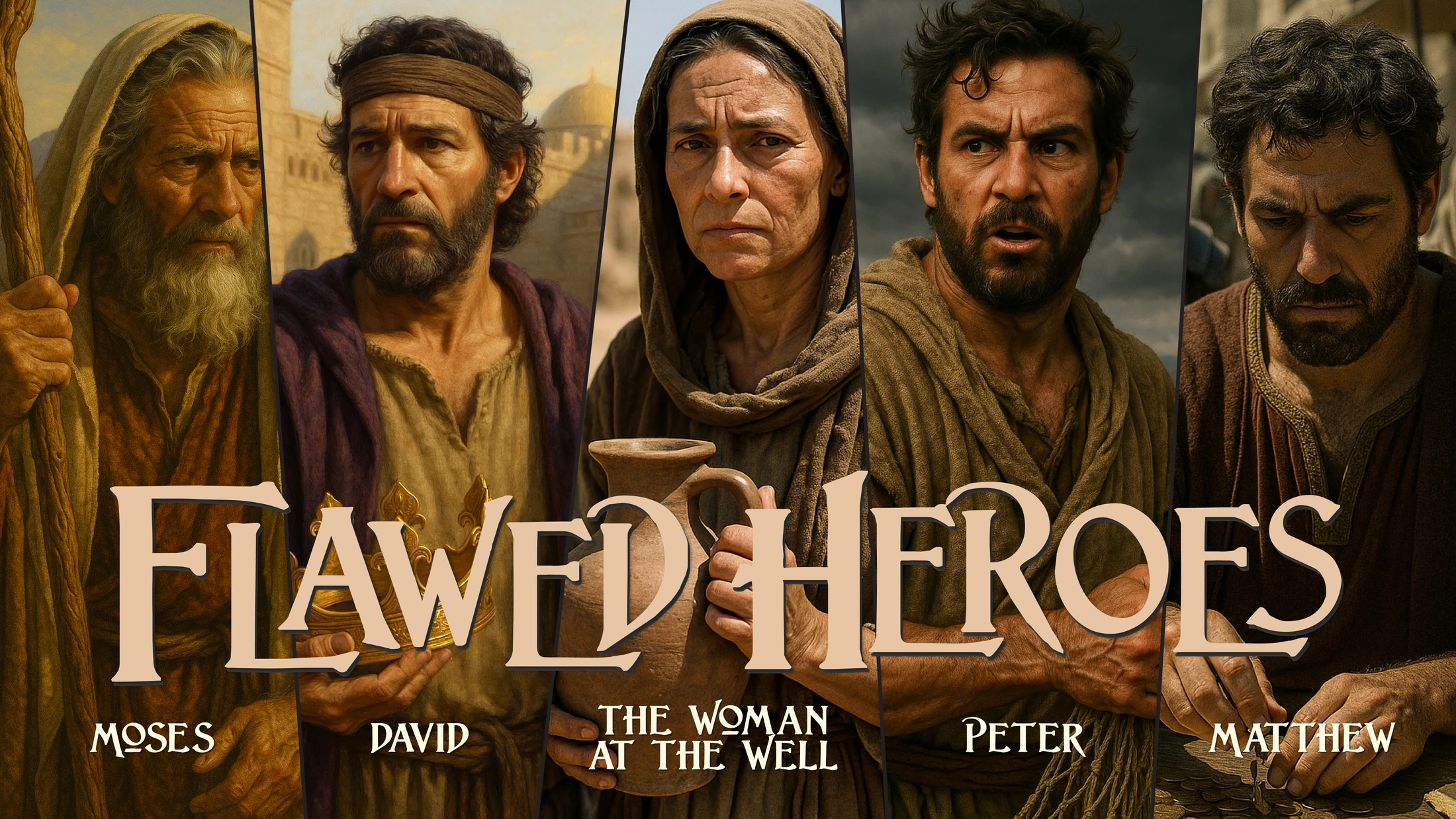
Good morning, friends. Welcome to our second week in this message series called Flawed Heroes. Many of you are aware there's a note in your bulletin to this effect. This has been a really hard and emotional week for our church family as we celebrated the life this past Thursday of our friend and colleague Steve Poston. We're grateful for the way that you have supported Steve's family, and we're honestly grateful for the way you've supported our staff.
It's been a big loss for all of us, but we're thankful that Steve is with Jesus and that we have the hope of a reunion. And I'm thankful that you're here. When we are struggling, when we're hurting, when we're going through difficult times, being together as a family is important. So thank you for being here today. I'm grateful to be with you.
Last week we began this series by looking at the life of Moses. Today we going to shift our focus, like Joel said earlier, to the life of a man named David. David was the youngest of his father Jesse's eight sons. He was born about 1040 B.C. in a town called Bethlehem that we know.
It's famous for being the birthplace of Jesus. But David worked as a shepherd, but he was also a talented musician. He played the harp and he wrote poems. He wrote songs. And somewhere along the way, David evidently developed some mad fighting skills too, because long before David became a soldier, which came later, he learned to use a sling and he would kill predators like lions or bears that threatened his dad's flock.
When David was young, Israel's first king, whose name was Saul, was rejected by God because of his blatant disobedience. And God sent Samuel, who at that time was Israel's judge and primary prophet, to anoint one of Jesse's sons as Israel's next king. So Samuel went and he interviewed all of Jesse's oldest seven sons, starting with the oldest. And Samuel took one look at Eliab was his name, and concluded, this must be the guy. He must have been a very kingly looking guy.
But the Lord said to Samuel, don't consider his appearance or his height, for I have rejected him. He is not the man I've chosen for this role. The Lord does not look at the things people look at. People look at the outward appearance. But the Lord looks at the heart.
And we're going to say more about David's heart here in just a few minutes, so hang on to that. Well, God went down the line and he said no to each of Jesse's seven oldest sons. And it appeared that his entire visit to Bethlehem had been a waste of time when Jesse finally brought David in from the field, and God told Samuel, this is the one. So right there in front of his family, David was anointed as Israel's future king. Now, after God rejected him, King Saul experienced spiritual oppression.
So David was brought in to play his harp. Saul liked David immediately. They hit it off. And Saul found David's music soothing. Well, Israel soon went to war with their enemies, the Philistines.
And David's three oldest brothers served in Saul's army. So Jesse sent David to the battlefield with Saul some supplies for his brothers. And when he got there, he saw that the Philistine army had this giant beast of a man named Goliath who stood over nine feet tall. This is a famous story. Each day, Goliath would step to the battle line, he would insult Israel, he would blaspheme God, he would dare anybody in Israel to come out and fight him.
And of course, nobody had any interest in playing that game. But when David arrived and he saw Goliath's taunts go unanswered, he was outraged. And in the most famous moment of David's life, armed only with a sling and five stones, David went to battle. As Goliath came at him, David wound up his sling. He drilled Goliath in the forehead with the rock, and Goliath fell.
And David took the giant's own huge sword and lopped off his enormous noggin. And Israel sprang to life and they won the battle. And David became an overnight hero. But David's popularity didn't sit so well with the king. Saul made David an officer in his army for obvious strategic reasons.
But Saul's jealousy of David prompted him to try more than once to kill David. And what made the situation even worse, what made it more complicated and. And more tense, was the fact that Saul's son, Jonathan happened to be David's best friend. And Saul's daughter Michal became David's wife. So at various times, both Jonathan and Michal had to intervene and save David from their father's attempts to murder him.
Well, eventually, David had to flee for his own life. He took his parents to the land of Moab, and he left them there for their protection. And then he hid in the desert. And. And more than once, Saul gathered armed men and he went in pursuit of David.
And each time, David managed to escape. But there were times in there where Saul was within easy reach and David could have taken his life and chose not to. Well, David cultivated A friendship along the way with Achish, who was a Philistine king of a place called Gath. And Achish gave David a city called Ziklag. And from Ziklag, David continued.
Even though he was keeping his distance from Saul, for his own safety, he continued fighting against Israel's enemies. Now, eventually, the Philistines went to war against Saul. And while David was away from Ziklag, Amalekite invaders from outside, they came in and they destroyed and looted the city. They took David's family and his followers captive, and that forced David to chase them into the desert, where he defeated them and reclaimed everything that they had taken. But while David was in the middle of reclaiming Ziklag, the.
The Philistines defeated Israel. And King Saul and his son Jonathan, David's best friend, were killed. And David mourned for both of them. And When David was 30 years old, the southern Israelite tribe of Judah made him their king. And David ruled Judah for seven and a half years.
But there was no peace. The northern tribes made Saul's son Israel. That's fun to say. They made Saul's son Ish Bosheth, their king. And that began a civil war between the northern kingdom of Israel and the southern kingdom of Judah.
But then Ish Bosheth was assassinated, and Israel and Judah merged, and David ruled that United Kingdom for 33 years. David conquered and he rebuilt Jerusalem. In that time, Jerusalem also came to be known as the city of David. And David brought the Ark of the Covenant. And as the Ark entered the city.
This is one of my favorite David stories. David, the king took off his outer royal robes, and he worshiped by dancing before the Lord. And I have no idea what kind of moves David had, but I can tell you his wife did not approve.
And probably some husbands in the room would relate to that. Even if you got some sweet dance moves, your wife might not approve of what David did here. She criticized him for acting like a fool. And David told his wife, plain and simple, I wasn't dancing for you. I was celebrating before God.
And it won't be the last time. I care way more about celebrating God's goodness than I do impressing other people. And every time I read this story, it makes me wonder how different our worship might be if we cared more about God's glory than we do about what other people think.
One of David's dreams was to build God a temple in Jerusalem. But God had other plans. Through the prophet Nathan, God said he would bless David, that he would give him a descendant whose throne would remain forever. And Israel then experienced a time of peace and prosperity. This period of David's life is really the golden age of Israel.
David was a hero, but he was a flawed hero. Second Samuel, chapter 11 tells about one spring when David sent his army off to war. But for some reason, he did not go himself. And that idle time was a huge mistake. One night, from the roof of his palace, he saw a beautiful woman taking a bath.
Now, David may have spotted her, he may have happened upon her innocently, but rather than turn away, he let his curiosity percolate and become lust. David learned that the woman's name was Bathsheba and that her husband, Uriah was one of his soldiers. So David had her brought to the palace where he slept with her as king. I mean, David had the power to take what he wanted. There is nothing in this text to suggest that Bathsheba somehow intentionally seduced him.
The this looks very much like another case of history's most powerful men taking advantage of sexual or taking sexual advantage of women just by virtue of their power and their position. So Bathsheba later sent word to David that she was pregnant, and David wanted to try to sidestep a scandal. So David quietly had her husband brought back from the battle. But Uriah refused to go home. While while his comrades were still at war, David tried getting Uriah drunk.
But even when he was inebriated, Uriah had more honor than his king and he refused to go home. So David sent Uriah back to battle, along with orders to put him where the fighting was most intense and then pull back and leave him exposed. And Uriah was killed. And David tried to pass the whole thing off as just one of those unfortunate casualties of war. Bathsheba mourned for her husband, and David took her as yet another wife.
And scripture records that the thing David had done displeased the Lord. So God sent Nathan the prophet to tell David a little bedtime story about two men. There was a rich man, Nathan said, who had vast herds of livestock. And there was a poor man who had only one lamb that he loved like his own child. And one night, that rich man had a visitor.
And rather than draw on his own immense resources, he took the poor man's lamb and he slaughtered it and he fed it to his guests. And when David heard that story, he was outraged. He was ready to take that heartless man's life. And that's when Nathan said, david, you are that man. God chose you.
He protected you. He blessed you. But instead of being Grateful. You ignored his commands and you sacrificed a loyal, innocent man and his marriage on the altar of your own lust.
David was used to people doing what he said.
He sent his army and they went to war. He sent for Bathsheba and. And she showed up. He gave orders and Uriah died. But David was not used to the way that Nathan got up in his face.
And that got David's attention, and he actually owned up to what he'd done. David said to Nathan, I have sinned against the Lord. Rather than try to deny it or minimize it or cover it up or just wallow in his shame, David took the entire situation. He owned up to it, and he took it to God. When you open your Bible right about to the middle, you'll come to the book of Psalms, and in Psalm 51, you'll find a heading that goes something like this for the director of music, a Psalm of David.
When the prophet Nathan came to him after David had committed adultery with Bathsheba, this entire incident prompted David to write Psalm 51, where we read these words. Have mercy on me, O God, according to your unfailing love, according to your great compassion. Blot out all my transgressions, Wash away all my iniquity and cleanse me from my sin. For I know my transgressions and my sin is always but before me, against you, you only have I sinned and done what is evil in your sight. So you are right in your verdict and justified when you judge.
Notice that David appealed to God's love and not his own righteousness. David didn't try to suggest that his sin really wasn't that big a deal. He didn't try to point to other people whose sins were way worse. He didn't try to argue that his overall track record, if you think about it, really was halfway decent. David acknowledged his guilt.
In fact, he could not shake it from his mind. He was painfully aware of his sin and his need for God's forgiveness, so he begged for mercy. David went on to say, hide your face from my sins and blot out all my iniquity. Create in me a pure heart, O God, and renew a steadfast spirit within me. Do not cast me from your presence or take your holy spirit from me.
Restore to me the joy of your salvation and grant me a willing spirit to sustain me. Then I will teach transgressors your ways so that sinners will turn back to you. Deliver me from the guilt of bloodshed, O God, you who are God, my Savior, and my tongue will sing of Your righteousness. Open my lips, Lord, and my mouth will declare your praise. David didn't just ask God to expunge his record.
He asked God to renew his heart, to reawaken him to the joy of salvation, to revive his desire to live for God. And David didn't just want that for himself. Did you notice that he wanted others to look at his story and learn from it so that they would turn back to God too. Sometimes we have to see somebody else's life transformed in a radical way before we begin to believe that that might be possible for us too. That's one of the reasons why we celebrate baptisms publicly whenever we can.
We want other people to have the opportunity to see what God is doing in people's lives. That's why it's so important that all of us who are following Jesus share our stories with others of the ways that Jesus is changing us. Now we see from the life of David that worship can take a variety of different forms. Sometimes that means singing to God. We do a lot of that around here on Sunday mornings.
Sometimes it's writing words of praise like the words that we just read from Psalm 51. It could be speaking to others of God's greatness, or simply being still before him, or using God given talent to make art that reflects his glory and beauty.
It could mean dancing before him. If you got more rhythm than some of us, it could mean simply obeying Him. But however it looks on the outside, worship always begins in our hearts. David concluded Psalm 51 with these words. He said, you do not delight in sacrifice, or I would bring it.
You do not take pleasure in burnt offerings, but my sacrifice. Oh God is a broken spirit, a broken and contrite heart, You, God will not despise. David came to realize that the worship God desires is not showy, dramatic things done for him, but surrendered, obedient hearts offered to him. That's a mouthful. So let me say that again.
The kind of worship that God desires from us is not the showy, dramatic, emotional things that we do for him. It is our surrendered, obedient hearts that we offer to Him.
Now. I wish I could tell you that after this Bathsheba incident that David's life leveled out. But the truth is, even when we confess our sin, even when we repent of it, even when we receive God's forgiveness, we remain flawed. We residence of a broken world and messy, painful consequences may still follow us. In David's story, the child that he fathered with Bathsheba died later.
David's son Amnon raped his half sister Tamar, and then Tamar's brother Absalom, another of David's sons, killed Amnon. This same Absalom led a rebellion, forcing David and those who were loyal to him flee. Civil war broke out in Israel and the result of that was that Absalom was killed. And then David found himself grieving the death of his son, even though Absalom had rebelled against him. David later won another war with the Philistines, but he defied God again when he took a census of fighting men.
There was a season when David chose to trust in the size of his army rather than the strength of his God. And God punished David David's arrogance with an outbreak of disease that killed thousands until David repented and the plague subsided. In David's later years, another of his sons, Adonijah, tried to seize power. But David intervened and he named his son Solomon, the son of Bathsheba, Israel's next king. David died around 970 B.C.
and was buried in Jerusalem. A few days ago, I read a blog in which Daniel Pentamon wrote this about David. He said despite his flaws, David was known as a man after God's own heart, the most pious of all Hebrew kings and the standard by which every other Judean king would be measured. The prophecy of a king whose throne would endure forever fueled messianic hopes among the Jews. Hopes which were finally fulfilled in the coming of Jesus, the physical descendant and promised son of David.
Now if we were to go on listing David's strengths, we might add his courage. We could talk about his patience in waiting, his turn to be king in Israel, his refusal to retaliate against Saul, even when Saul was trying to kill him on a regular basis. We could talk about David's Holy Spirit, inspired by prophetic gifts that God used to help him write the Psalms. For all of these reasons, it's not a hard thing to call David a hero. But David was obviously very flawed and a number of people look at the life of David.
In fact, some of the people who read Daniel Pentamon's blog ask this question in the comments. David was guilty of lust and adultery and murder. He married multiple wives. He raised some very spoiled, self centered, immoral kids. How in the world could he be called a man after God's heart?
How is that possible? And that's an important question. It's an obvious question. It's a challenging question. And to answer it we have to consider three things.
Number one, God's people, like all people, have sin in our stories. Now in this series we're in the middle of right now, we're focusing specifically on Moses and David. And next week we'll look at the woman at the well. In John chapter four, we're going to look at the apostle Matthew and the apostle Paul, all of whose lives were scarred by sin and yet who were used by God. But we didn't choose these five people because they're the only five characters in Scripture.
That's true of they're just a representative sample of all humanity. I mean, with the exception of Jesus. Flawed, sinful, screwed up people are the only kind there are. The Apostle Paul wrote in Romans chapter three that all. All.
What percentage of people are we talking about? 100%. All people have sinned and fall short of the glory of God. Which means that if you're looking for a perfect church full of perfect people, led by perfect pastors, you. You're going to be very disappointed here.
And you'll be disappointed by the next church you go to and the church after that and the church after that. The second thing we have to understand is that God's people are forgiven, not flawless. What we see in Scripture is that God can forgive the selfishness and the evil and the rebellion in our hearts, but that does not make our sin okay. Sin always grieves God. Sin always corrupts us.
Sin always hurts people. Sin is a big deal and God hates it. That's why Paul asked the Corinthian Church this question. Paul asked. Do you not know that wrongdoers will not inherit the kingdom of God?
Do not be deceived. Neither the sexually immoral, nor idolaters, nor adulterers, nor men who have sex with men, nor. Nor thieves, nor the greedy, nor drunkards, nor slanderers, nor swindlers. Have we missed anybody yet will inherit the kingdom of God. And I don't know about you, but I have seen people cherry pick and weaponize certain portions of those two verses in order to clobber certain people for their sins.
But that was not Paul's point because he didn't stop there. After that laundry list. Paul went on to say this. And. And that is what some of you were.
But. But you were washed, you were sanctified, you were justified in the name of the Lord Jesus Christ and by the spirit of our God. What Paul is saying is there is no sin out there that hasn't already existed in here in our own hearts. If we could roll all of our lives into one big narrative, our collective story would include virtually every behavior that God has ever warned us to Avoid. We've all blown our shot at perfection.
Jesus followers are no better than anybody else. We just happen to know that that Jesus took our punishment at the cross and that when we trust that sacrifice, our sin is no longer what defines us. When we bring our lives under the umbrella of the lordship of Jesus, God views us from that point forward through the lens of Jesus holiness and perfection. Scripture calls that being justified. That means declared righteous.
But it doesn't stop there, because number three, God's people are becoming more like Jesus, but we aren't there yet. When we surrender to Jesus as Lord and Savior, he calls us to repent. He calls us to turn away from our sin. He calls us to change, to begin this lifelong process that Scripture calls sanctification, which is a fancy word for being shaped from within by God's Holy Spirit to become more and more like Jesus. Jesus.
Sanctification is about knowing that if we're going to follow Jesus, we can't keep living the way that we used to. Sanctification is about learning to live in the reality of our justification. Justification is when God says, because of your faith in my son Jesus, I declare that you are righteous. Sanctification is the Holy Spirit moving into our lives and working at our character, transforming us from the inside out so that more and more and more our character begins to reflect what God has already declared to be true about us. That is what made David a man after God's heart.
The name John Newton might ring familiar with a few of us because John Newton wrote a famous song called Amazing Grace. But before John Newton wrote that hymn, he was the captain of a ship that was involved in the African slave trade. And John Newton came to a point in his life where he repented of his involvement in that evil. And he became a very outspoken opponent of slavery. In addition to Amazing Grace, which is a song whose lyrics many of us would know by heart, Newton made this statement that I love.
John Newton said, I am not what I ought to be. I am not what I want to be. I am not what I hope to be in another world, but still I am not what I once used to be. And by the grace of God, I am what I am.
One of the saddest moments in my growing up years was the night my dad, one of the people I respect most, called a family meeting to share that he and my mom were separating. That was heartbreaking. But even more so was my dad's confession that he had had an affair. My parents eventually divorced, and that whole series of events was traumatic for Our family. I mean, I was disappointed by my dad's actions.
But I can tell you this. I never once heard my dad defend or condone what he'd done in any way. My dad taught me a lot of powerful lessons, but one of the most powerful things I ever learned from my dad was the way he chose to live after that moral failure. Because rather than rationalize or justify his actions, I just saw my dad repent and lean into the grace of God and live intentionally and faithfully. Dad kept loving my siblings and me.
He continued to pursue the Lord. He worked hard. He cared for others. And when people who knew about my dad's past would write him off on that basis, and he didn't protest, he didn't lash back at them. He just kept on living with a renewed commitment to integrity.
Later, dad wrote my mom a really heartfelt letter apologizing for the terrible hurt that he had caused all of us. And I saw my dad emerge from that season more humble and more patient and more compassionate and more gracious ever. Dad returned to working in ministry, and he became a hospital and hospice chaplain. And I believe my dad's greatest kingdom impact came in those last 20 or so years of his life that gave him daily access to thousands of people who would never have walked through the doors of a church. Many of you know, because I've talked about this several times, that my dad died really suddenly in 2014.
And in the days following Dad's death, we found a folder of poetry in Dad's office. My dad was a really gifted writer, and he did a lot of that. And my favorite of dad's poems is one that he'd written just two years before he died called what I Once Was. And this is what dad wrote.
What I once was I need not be again Today I live and learn I know that I can find a better way the open wounds of yesterday the hundred pains I'd feel Are now just scars I bear Today I'm learning how to heal what I once was I need not be again today Old wounds, new scars and even those in time will fade away what took me down can lift me up it all depends on me the willful blind can change his mind and soon he too can see what I once was I need not be again today Fell a thousand times yet still I stand and I will be okay I wronged, I failed I quit, I bailed I hurt the ones I love but here I am a better man I've learned to look above what I once was I need not be Again today I've said goodbye and now I try to walk a different way the path behind was so uncommon it soon will disappear I'm a man alive to try to strive and all's forgiven here I've learned from David and from John Newton and from my dad and from a whole bunch of other people that God uses the repentant, not the perfect.
Whatever our sins, whatever our flaws, whatever our failures, Jesus died for them. He paid for our sins in full with his life. And he invites all of us to be cleansed and made new by turning away from them, by giving our guilt to him and inviting His Spirit to create a new heart within us we don't have to cure, carry our past forever. God uses the repentant, not the perfect.
Joel has written a song called Unfailing Love that comes directly from the words of Psalm 51 that we just unpacked together a few minutes ago. In just a minute, Joel and our worship team are going to lead us in a time of personal reflection by sharing that song with us. And as they sing, as they play, I just want to ask all of us to ask ourselves this question. Where do I need God to renew my heart?
Do I need him to wake me up from spiritual apathy? Is there an ungodly habit in my life that it's time for me to nail to the cross? Do I need to repent of self centeredness and obliviousness to other people's diseases needs? Do I need to reallocate time and energy so that God finally gets more than just my leftovers? Is it time for me to give up a materialistic mindset that prevents me from being generous in the way that God calls me to?
Is there an immoral relationship that I need to walk away from? Am I harboring hatred and bitterness in my heart that I need to let go of? Do I need to stop just passing the time and just drifting through life and learn to live on mission focused on the things that matter most to God? I don't know what question the Holy Spirit wants you to grapple with right now, but I'm confident that if you use these next few minutes to ask him to reveal that to you, he'll do that. So let's invite the Holy Spirit to speak to our hearts as we listen to this song.
Have mercy on me, O God because of your unfailing love because of your unfailing love have mercy on me, O God because of your unfailing love because of your unfailing love For I recognize my rebellion it haunts Me day and night against you and you alone I have done evil in your sight I was born betrayed, promise breaker, sinner from the start I surrender to you alone the one who holds my heart creating me Come clean heart Create in me a clean heart, oh God Every new right spirit within me Create in me unclean heart Creating me Clean heart, O God and renew right spirit within me have mercy on me, O God because of your unfailing love because of your unfailing love have mercy on me, O God because of your unfailing love because of your unfailing love For I recognize my rebellion it haunts me day and night against you and you alone I have done evil in your sight I was born betrayed, promise breaker and sinner from the start I surrender to you al you're the one who holds my heart Creating me a clean heart Created me a clean heart, oh God Every new right spirit within me Created me Clean heart Created me a clean heart, oh God, and renew a right spirit within me Father, cast me not away from your presence Lord, I pray Holy Spirit, have your way in me in me Father, cast me not away from your presence, Lord, I pray Holy Spirit, have your way in me in me Created me the cleaner Created me the cleaner, oh God, can be newer Right spirit, spirit within me created me Complete me, O God, can renew a right spirit within me have mercy on me, O God because of your unfailing love because of your unfailing love.
Another one of those psalms that David wrote, Psalm 103, is where he made the statement that as far as the east is from the west, that's how far God has removed our sins from us. And God does all of that through the sacrifice that Jesus made for each of us at the cross.
Every time we come together, we want to invite you to respond to what God is teaching us. God didn't give us scripture just so that we could read it and have our hearts warmed and then put it away. It's not just facts to read or stories to study or knowledge to memorize. It's designed to transform us from the inside out. And so every time we're together, we certainly want this to be an enjoyable experience.
But our hope and our prayer is always that more than just people saying, I enjoy enjoyed that, or I really liked that song, or boy, that that poem made me cry. What we really want is for the Holy Spirit to have free reign in our lives, to show us what needs to be surrendered to his control. And so we just want to invite you every time we're together to respond. If that's a question you need to ask or a conversation that you need to have, maybe a step that you need to take. Maybe you're ready to surrender your life to Jesus as Lord and Savior.
We'd love to celebrate that with with you. Maybe you hear us talking about surrendering your life to Jesus as Lord and Savior, but you're still not totally clear on what that means. We'd love to talk about that. Couple of easy ways you can reach out to us. I'm going to ask our our next step team to make their way down front if you guys would do that for me.
But all of our friends online and anybody here in the room that might just be in a hurry today, or maybe you're a little apprehensive about a face to face conversation right off the bat, we would just invite you to text the word next to 317-707-9997. That will get you in touch with our team so we can get in touch with you and begin a conversation about whatever God is stirring within you. But if you're here this morning and I can see your face right now, if we have the opportunity right after the service, we would love. We've got several friends down here. We'd be happy to pray with you, answer questions, do whatever we can to help connect you to whatever next stop, next step God is calling you to.
Like I said before, it's been a heavy week around here, but we also have had a very hopeful week because of who Jesus is and what he's done for us. I'm grateful that you're here. Thank you for making this a priority. Let me lead us in prayer and then we're just going to invite God through His spirit to guide us. And if we can be of help to you, please come and find us down front after the service.
Heavenly Father, we're thankful for your goodness to us, for your unfailing love.
Lord, we ask you, we just echo the words of David. We ask you to create in us a clean heart.
Father, many of us are aware of our sins in a really deep and painful and heavy way. And we ask for your help, God, in surrendering that burden to you. Father, there may be some.